Monday, October 24, 2011

Sonny Terry Forever!

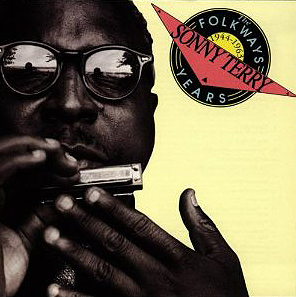
Country blues harmonica legend Sonny Terry would have been 100 years old today. Sonny Terry (Terrell Saunders) was born in Greensboro, North Carolina, on October 24, 1911.  His early musical training consisted of listening to his father play hoedowns and square dance tunes on the harmonica. Though he played in various string bands around the Shelby, NC area, Sonny had no intention of becoming a professional musician until two separate accidents, at the ages of eleven and sixteen, left him virtually blind in both eyes. Farming was no longer an option. After losing his sight, Terry took to the streets and medicine show circuit where his skilled harmonica playing drew large crowds. Sonny developed a strong rhythmic style that included lots of chugs, whoops, wails, and hollers. He used his hands, harmonica, and voice to create trademark sound effects, from baying hounds to lonesome whistles and driving locomotives. When Sonny was about eighteen years old he got his first taste of the blues and taught himself how to play his harmonica in the cross harp blues style. Sometime in 1937, while out busking on the streets, Terry met his future musical partner – guitarist Blind Boy Fuller. The pair formed a strong musical bond and played together for the next four years, until Fuller passed away in February of 1941 at the unripe not old age of thirty three years. Soon after Fuller's death guitarist Brownie McGhee was asked to accompany Terry on a trip to Washington DC, and so the seminal acoustic blues harmonica/guitar duo of Sonny Terry and Brownie McGhee was formed. The pair moved to New York in 1942 and became hugely successful in the New York City folk and blues scene of the 40s and 50s.  Sonny's solo playing had already been a big hit in New York since he performed in John Hammond's famous "Spirituals to Swing" concert at Carnegie Hall in 1938. In the 1940s, Terry's unique style landed him a part in the Broadway play "Finian's Rainbow", the show ran for five years. In the next decade Terry and McGhee appeared as a duo on Broadway in a three year run of Tennessee Williams "Cat on a Hot Tin Roof."

By the time I saw Sonny Terry and Brownie McGhee perform together in the 1970s, they were still making great music together, but a rift that had been developing for some time was beginning to take its toll on the dynamic duo. They often argued offstage and by the 1980s they were no longer performing as a duo. Sonny spent his later years living on Long Island and passed away in Mineola, NY, on March 11, 1986. Thankfully, he left behind hundreds of recordings in the pre-blues and early Piedmont blues harmonica styles, as well as a legion of young players, including Phil Wiggins and our good friend Ken "The Rocket" Korb, who have been inspired to carry on the country blues harmonica tradition. Terrell Saunders was a true giant in the history of American music.


Sonny Terry CD: The Folkways Years, 1944-1963

Sonny Terry DVD: Whoopin' The Blues 1958-1974

Little Toby and the Rocket 2011 Reunion on The Long Island Blues Warehouse Show

John Cephas and Phil Wiggins perform at the White House July 1999

Thursday, October 13, 2011

Song Sprouts Artist of the Day


On Friday, October 14th, 2011, The Homegrown String Band will be the Featured Artist of the Day on the independent music site SongSprouts.com. Song Sprouts is a very cool site where music fans can listen and download music that has been posted free of charge by 915 independent artists. If you go to our fan page you can listen to three songs (Praying for Spring, Don't Let Your Deal Go Down, and A minor Catastrophe) from our Ragged but Right CD. If you create a fan account you can download Mp3s of the three songs absolutely FREE! Song Sprouts is a great way to discover new music. Check out the music posted by The Homegrown String Band and about 914 other independent bands and solo artists.

Our local Long Island fans can also get some free live music this weekend as the full band will be doing a free show as part of the West Hempstead Library's Sunday at Two Series. You probably guessed that the show is on Sunday at 2pm. If you did, you would be correct!


West Hempstead Public Library
500 Hempstead Ave
West Hempstead, NY 11552

2:00 pm
 Sunday October 16th, 2011

Wednesday, September 21, 2011

Garlic Time!


It's harvest season in New York! Over the past couple weeks we have played the Tomatoes and Tunes Festival in East Meridith, NY, and the Apple Festival in Setauket, NY. This weekend The Homegrown String Band returns to the world famous Hudson Valley Garlic Festival in Saugerties, NY. The HVGF is the biggest food festival on the east coast. Besides great food, fresh produce, cooking demonstrations, and lectures there will also be hundreds of craft vendors and 5 stages featuring 10 musical acts. We will be sharing the East Marketplace stage with the Barefoot Boys, a great traditional duo from the Catskill region. Also appearing will be: The Mojo Myles Band, Annie and the Hedonists, Captain Squeeze & the Zydeco Moshers, Mark Rust, One World Puppetry, and The Arm of the Sea Theater. Garlic growers and garlic lovers from around the country make the annual pilgrimage to Saugerties to sample the gourmet cuisine and to stock up on fresh organically grown garlic from around the region. Come join us in this festival that celebrates the wonders of "The Stinking Rose."

Sunday, August 7, 2011

What's a Connetquot?

 On Wednesday, August 10, 2011, at 7:00 pm the Homegrown String Band will be presenting a free concert at the Connetquot Library in Bohemia, NY. The word Connetquot means "Great River" in the language of the Secatog (Secatogue) people. The Secatogs were a Delaware-Algonkian community that lived on the south shore of Long Island, from Copiague to Bayshore. They were one of thirteen "tribes," identified by Suffolk County Historian Paul Bailey in his 1959 pamphlet "The Thirteen Tribes of Long Island," living on the island when European settlers arrived in 1635. 


Connetquot Public Library
760 Ocean Ave
Bohemia, NY 11716
(631) 567-5079

Sunday, July 31, 2011

Old and New


The Homegrown String Band has always been about blending the old with the new. For the last 15 years we have been performing a mix of original songs along with original arrangements of traditional American music. Throughout our performing career the unique approach we take, to what is essentially traditional music, has gone in and out of fashion. Our music has alternately been embraced and shunned by the gate keepers of various musical genres. We try to remain true to tradition, not being influenced by musical fads and fashions, while also being open to change and evolution. American music is all about cross pollination and the exchange of ideas. The Carter Family,  Charlie Poole, Jimmie Rodgers, Bill Monroe, Hank Williams, Chuck Berry, Elvis Presley, Bob Dylan, and  Jerry Garcia were all people who added their own ideas to the canon of traditional American music. Some people  may choose to latch on to the music of an individual, a musical genre, or a particular stylistic era, believing that a particular style and or instrumentation are the ultimate and final word handed down by the musical gods; we believe in continuing revelation.

Monday, July 25, 2011

Aptucxet Trading Post

On Wednesday, July 27, 2011, at 7:00 pm the Homegrown String Band will be presenting a free outdoor concert at the Jonathon Bourne Public Library in the historic town of Bourne, Massachusetts. Though the town wasn't officially incorporated until 1884 the area had been an important gathering place for centuries before. In 1627 the Pilgrims established the Aptucxet trading post on a site known as Manamet, "trail of burden carriers," by the native peoples. Today the town situated on Buzzards Bay is known as the gateway to Cape Cod.

On Thursday, July 28, at 7:00 pm the band will be playing a free indoor show at the Oliver Wolcott Library in Litchfield, Connecticut. The OWL is named in honor of Declaration of Independence signer Oliver Wolcott, a brigadier general of the Connecticut Militia during the American Revolution, and former governor of Connecticut.

Friday, July 22, 2011

Charlie Poole by Tracy Bigelow Grisman

A few years ago we (The Homegrown String Band) were playing at a bluegrass festival headlined by David Grisman. I found a beautiful water color like print of a famous photo of the Carter Family at his merchandise table. I couldn't resist. I bought the print, framed it, and hung it up in my music room right next to an 8X10 photo of Tommy Jarrell and Fred Cockerham given to me by the late Ray Alden. The painting was made by Tracy Bigelow Grisman; a talented artist and musician from Petaluma, California . She has a web site, called OldtimeyArt.com, where you can see and purchase her beautiful prints of old-time country and jazz musicians.

Last week I was rummaging through eBay, looking for banjo ephemera, and I came across an auction for an 11X14 print of Charlie Poole done by Tracy. I won the auction and Charlie is now hanging with the Carters in my music room. I hope the Carters don't mind hanging out with this hard drinking rounder from North Carolina; Maybelle put up with Johnny Cash so I guess she'll be OK with Charlie. While the Carter Family advertised their shows as wholesome and "morally good;" Charlie Poole was at the other end of the spectrum. This hard drinking millworker made his own whiskey and played with his band, the North Carolina Ramblers, at speakeasies, mining towns, and lumber camps around the Piedmont area. Like the Carters, Charlie was an innovator, blending traditional mountain music with the popular music of the day. His three finger banjo picking was a precursor to the bluegrass banjo style made popular by Earl Scruggs. The music of Carter Family and the North Carolina Ramblers laid the foundation for the bluegrass bands of the 1940s and 1950s—and the Homegrown String Band.


Charlie Poole Music
You Ain't Talkin' to Me: Charlie Poole and the Roots of Country Music

Carter Family Music
The Carter Family: 1927-1934

Read about the musical contributions of Charlie Poole and other Piedmont textile workers to the development of American roots music.
Linthead Stomp: The Creation of Country Music in the Piedmont South