Tuesday, August 28, 2012

Ed Pressnell: Dulcimer Maker

Photo by Paul Macatee
Georgianne usually plays her dulcimer on a song or two in each of our Homegrown String Band sets. She received her first mountain dulcimer as a fifteenth wedding anniversary present, from yours truly, in 1994. Over the years she has developed her own unique chording style that fits in well with the band and gets a more featured role in our Homegrown Two duo shows.

The Appalachian dulcimer is a type of zither developed and popularized by folk musicians from the southern Appalachian region of the United States. This unique instrument owes much of its beauty, both visual and musical, to its elegant simplicity. Audience members are often fascinated by the look and sound of this traditional American folk instrument.

Here's a short film profiling traditional dulcimer builder Ed Pressnell, produced by Thomas Burton and Jack Schrader in 1973.

Friday, July 27, 2012

Putnam County 4H Fair

Our Homegrown Two show in Herald Square scheduled for this afternoon has been canceled because the threat of thunder and lightning was just too frightening. Hopefully we will be able to reschedule another date later this summer.

The full band will be performing two sets this Sunday at The Shady Grove Ampitheater on the grounds of the Putnam County 4H Fair in Carmel , NY. Our sets are at 1:00 and 3:00 pm. We will be sharing the stage with other local, regional, and nationally known performers. Music runs from 11:00 am to 5:00 pm.

Putnam County Veterans Memorial Park
201 Gipsy Trail Rd.
Carmel, NY 10512

Monday, July 23, 2012

Summer Tails and Tales from the Garden and the Road

Strange Tail from the Homegrown String Band Garden
Well, we are deep into summer now. The garlic is cured and the tomatoes, including this funky little plum tomato with a tail, are making their way to the dinner table.

The band just got back from a hot trip to Delaware and the Jersey Coast. We played a concert at Stango Park in Lewes, DE, on Tuesday and another in Ocean City, NJ, the following day. On Tuesday afternoon in Dover, DE, where we spent the night, the mercury hit 107 degrees. By the time we took the stage in Stango Park that evening the temperature had dropped to a "comfortable" 98 degrees. It really wasn't too bad, we were well shaded and there was a nice sea breeze coming off the ocean. The audience and concert presenters in Lewes were a pleasure, as always. In Ocean City we played to a lively audience in a nice theater style room located in the library section of the Ocean City Community Center, which also houses a cafe, a museum, an art gallery/studio, and a fitness center.

This Friday, July 27th, Georgianne and I will be doing a Homegrown Two show in Herald Square Park at 35th Street and 6th Avenue in NYC. It's a free lunch time concert in the park and runs from 12:30 to 1:30. On Sunday, July 29th, The Homegrown String Band will be doing two sets at "The Shady Grove Theater" during the Putnam County Fair at the Putnam County Veterans Memorial Park in Carmel, NY. Our set times are 1:00 pm and 3:00 pm.

Photo by Rick Jackofsky

Wednesday, July 4, 2012

Ophio Garlic Harvest 2012

2012 Garlic Harvest photo by Rick Jackofsky

Our show at the Ossie Davis Theater last night went very well, and I'd like to thank everyone who came out on a holiday night to see The Homegrown String Band in action. I hope you all had as much fun as we did.

I harvested my garlic today, about a week earlier than I had planned. We had a very warm winter this year and I'm not sure if that helped or hurt the garlic. We harvested our garlic scapes three or four weeks ago. This year, I lost about 10% of my crop to some sort of root rot and the 90 bulbs I dug up today were all small to medium size. People often ask me when they should harvest their hard necked (ophio) garlic. I usually go with the rule of thumb (green thumb, of course!) that you should harvest when half of the leaves have turned yellow. The remaining green leaves represent the layers of protective "paper" that will protect the garlic during curing and winter storage. If you let all the leaves die back there will be no paper wrapping the bulbs. You also run the risk of the heads over ripening and beginning to open up, which creates an opening for moisture and disease that will drastically shorten the storage life of your garlic. We were eating garlic from last year's harvest into March this year. Another thing to remember when harvesting garlic is that you should never harvest from wet ground. I usually stop watering my garlic patch a week or two before I plan on harvesting. Now I will dust off the loose dirt and cull out any damaged heads, which we will use uncured, then I'll let the rest of the garlic cure in a cool, dry, well ventilated area (our kitchen) for about two to four weeks. At that point, I will cut off the tops, trim the roots, take off the outside layer of dirty paper, and store the bulbs in mesh bags in our basement. When we perform at the Hudson Valley Garlic Festival in September I will try to find some garlic with bigger cloves to use as seed garlic for my fall planting. If not I will pick the biggest cloves from my harvest; "plant the best and eat the rest!"

Monday, July 2, 2012

Ossie Davis Theater - July 3, 2012

Tomorrow (Tuesday, July 3, 2012) at 7:00 p.m. The Homegrown String Band will be kicking off Independence Day festivities with a performance featuring the music and dance of rural America at the Ossie Davis Theater; a beautiful intimate 145 seat theatre located in the New Rochelle Library.


New Rochelle Public Library
1 Library Plaza
New Rochelle, NY 10801

 914-632-7878

Friday, June 29, 2012

A New Arts and Crafts Movement


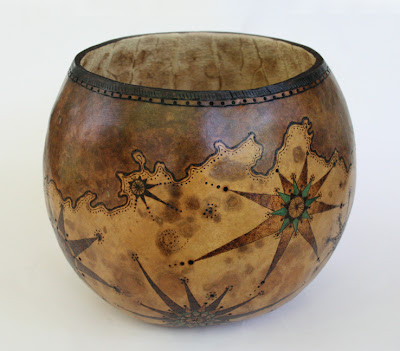
Gourd bowl with pyrographic design by Georgianne Jackofsky

In the late nineteenth century and early twentieth century a movement, led by English writer and artist William Morris, sought to restore the glory and appreciation of traditional craftsmanship. The movement took place at a time when the industrial revolution and machine-made products were devaluing skills that had been refined by artists and craftsmen throughout the course of human history. Once again we find ourselves at a crossroads in human history; where artists and designers with unique and valuable skills are being replaced by machines. This time the machines are not the steam, coal, and electric powered inventions of the nineteenth century, but the digitally controlled computer programs of the twenty-first century. There is a New Arts and Crafts movement taking place right now and it is happening on a global scale. In the last century, the movement was centered around schools, communities, and individuals dedicated to preserving traditional art forms. This time around the movement has no clear leader or epicenters of activity. One reason for the difference between the twentieth century movement and the twenty-first century movement is that the same technology that is creating the need for the movement is also aiding the movement by providing easy availability of tools and the rapid dissemination of the information needed to learn the practice, as well as the appreciation, of traditional art forms. The digital genie is out of the bottle and there is no turning back to the age of analog technology, but we should follow the advice of William Morris by recognizing the talents of traditional artists and craftsmen, giving the simple beauty of traditional folk art the respect it deserves.

Now for some shameless self promotion. The Homegrown String Band not only creates homegrown and handmade acoustic music, we are also practitioners of traditional arts and crafts. Annalee has created her own line of handmade soaps and lotions, Erica is a well known knitter and designer who creates original knitting and crochet patterns as well as a line of hand dyed yarn. Georgianne is an amazing artist who creates incredible works of beauty using pyrography (drawing with fire) on wood and gourds, as well as fashioning copper, brass, and aluminum wire jewelry. I work in copper, silver, pewter, wood, and fiber to create jewelry, decorative art, spoons, bowls, buttons and Navajo spindles

You can find us hawking our wares, every Sunday (if we are not doing a show) through November, at The Rocky Point Farmers Market located on Prince Road just east of Broadway (Old Depot Park) in Rocky Point, NY. We put up two tents and several tables displaying soaps, sundries, jewelry, gourd art, copper bowls, knitwear, and hand dyed yarn. Stop by and support the New American Arts and Crafts Movement. While you're there you can also stock up on organic produce, nursery stock, eggs, grass fed beef, free range chickens, and maybe catch a few tunes.

Wednesday, June 13, 2012

Homegrown Two - The Edison Sessions


On Saturday, June 2, Georgianne and I had the pleasure of taking part in an Edison wax cylinder recording session on the grounds of the Thomas Edison National Historic Park in West Orange, NJ. The machine used for the session was over a hundred years old, using technology from the late nineteenth century. This acoustic recording technology was the industry standard up until the electric microphone was invented in 1925. The sonic vibrations were picked up by a large horn with a diaphragm attached to a needle at the narrow end. The sound waves cause the diaphragm to vibrate as the needle engraves a groove on a wax cylinder being turned by a wind-up motor. As the recording was taking place, the recording engineer, museum curator Jerry Fabris, was constantly blowing wax debris away from the engraver. The recording time limit was two minutes. We recorded three tracks; one solo banjo and vocal track that didn't come out due to a defect in the cylinder, and two tracks with guitar, banjo-uke, harmonica, and vocals. Here is the digitized version of our take on the ever popular Doctor Humphrey Bates and the Possum Hunters classic "How Many Biscuits."


All the other bands that took part in the session were loud instrumental brass bands who were able to be picked up while performing about six to ten feet away from the sound gathering horn. Because we played quieter stringed instruments, we had to move right up to the horn. I actually stuck my head into the horn while singing. Now we have first hand experience that taught us why the golden age of string band recording took place in the mid to late 1920s, after the invention of the electric microphone made it possible to record vocals and stringed instruments with improved fidelity.